

Flow equalization
-under fluctuating flow conditions
We explain flow equalization
An SPS flow equalization stage provides an efficient, long-term solution for facilities with highly variable wastewater loads. In buildings such as community centers, churches, parish halls, event venues, and motor stadiums, peak flows often occur during short periods of intensive use, followed by days or even weeks of minimal or no activity.
Such uneven loading can strain conventional treatment plants, but a flow equalization stage helps balance the inflow, protecting the system and ensuring optimal performance.
The Problem with Uneven Loads
When many people use the wastewater system simultaneously, a sharp peak in load occurs. A treatment plant that is not designed for this may become hydraulically overloaded, which reduces treatment efficiency.
At the same time, biological treatment processes rely on continuity. The microorganisms that break down organic material require a steady supply of nutrients. If the system remains nearly unused for extended periods, biological activity declines.
The result is reduced stability and lower treatment performance.
How a Flow Equalization Stage Works
A flow equalization stage functions as a buffer for variable wastewater loads.
During periods of high inflow, wastewater is temporarily stored in a dedicated tank and then discharged to the treatment plant at a controlled, uniform rate. This prevents sharp flow peaks and allows the plant to operate under stable hydraulic conditions.
By smoothing out fluctuations in wastewater volume, the system ensures consistent biological activity and optimal treatment performance, regardless of variations in actual usage.
Economic Advantages
Wastewater systems are often designed according to a building’s occupancy rating. If a building is approved for 150 people, the system is theoretically expected to handle the same load.
In practice, however, the building is rarely used to full capacity. Instead of installing a treatment plant sized for 150 people, it is possible to choose a plant for, for example, 20 people and supplement it with a flow equalization stage.
This approach offers:
• Lower investment costs
• Reduced installation work
• Lower energy consumption
• Decreased service and maintenance costs
• The ability to avoid oversizing the system—without compromising performance
Enhanced Biological Function
A treatment plant operating under steady, controlled flow conditions maintains higher efficiency over time.
Stable flow ensures that microorganisms have optimal conditions for breaking down organic matter, leading to:
• Consistently reliable treatment performance
• Improved effluent quality
• Lower risk of operational disturbances
• Extended system lifespan
By balancing flows, the flow equalization stage protects both the mechanical components and the biological processes within the system.
Enhanced Operational Reliability
Sudden flow peaks can lead to hydraulic overload, impairing sludge separation and biological treatment efficiency.
By incorporating a flow equalization stage, these peaks are smoothed out. Wastewater is delivered at a controlled, uniform rate, minimizing the risk of overflow and unexpected operational issues.
This ensures safer, more predictable, and stable system operation over time.
A Sustainable and Efficient Solution
For facilities with intermittent high usage, a flow equalization stage offers the most practical approach.
By designing the system according to actual demand rather than theoretical peak load, it delivers:
• Lower overall costs
• Consistent and efficient treatment performance
• Enhanced biological function
• Reduced energy consumption
• Improved operational reliability
The SPS flow equalization stage is more than just a component—it is a long-term investment in system performance, economy, and sustainability.
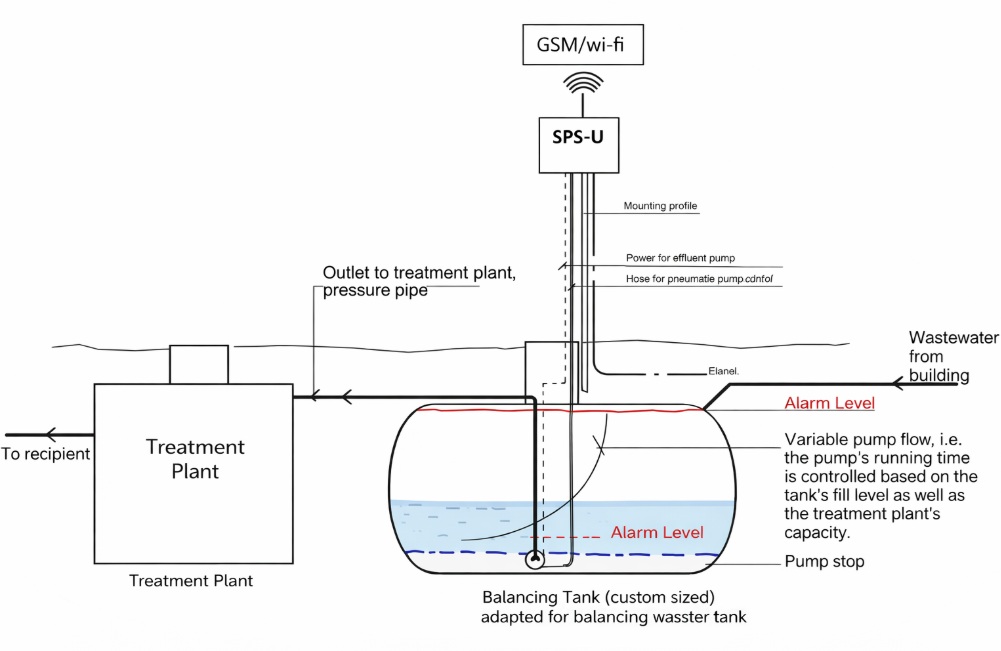
To construct flow equalization
We conduct comprehensive project planning to evaluate the maximum number of users over a week, a month, and a year, as well as the number of toilets, showers, kitchens, and other facilities. This data is then compiled into our design parameters. Based on these parameters, a flowchart is created to determine the required size of the treatment plant and the flow equalization.
Once the system is installed, the flowchart is uploaded into the PLC control system. The control system operates the pump, which transfers the wastewater according to the settings and the tank level to the treatment plant. The system is connected to our Septikcon database, where the amount of water being sent to the treatment plant and the fill level of the leveling tank can be clearly monitored. An LCD display is installed in the control cabinet, allowing adjustments to be made on site. We can also remotely control functions from the office if necessary.